Malicious Browser Add-Ons Caught Replacing Revenue Links, Draining ChatGPT Credentials From The Oblivious Flock

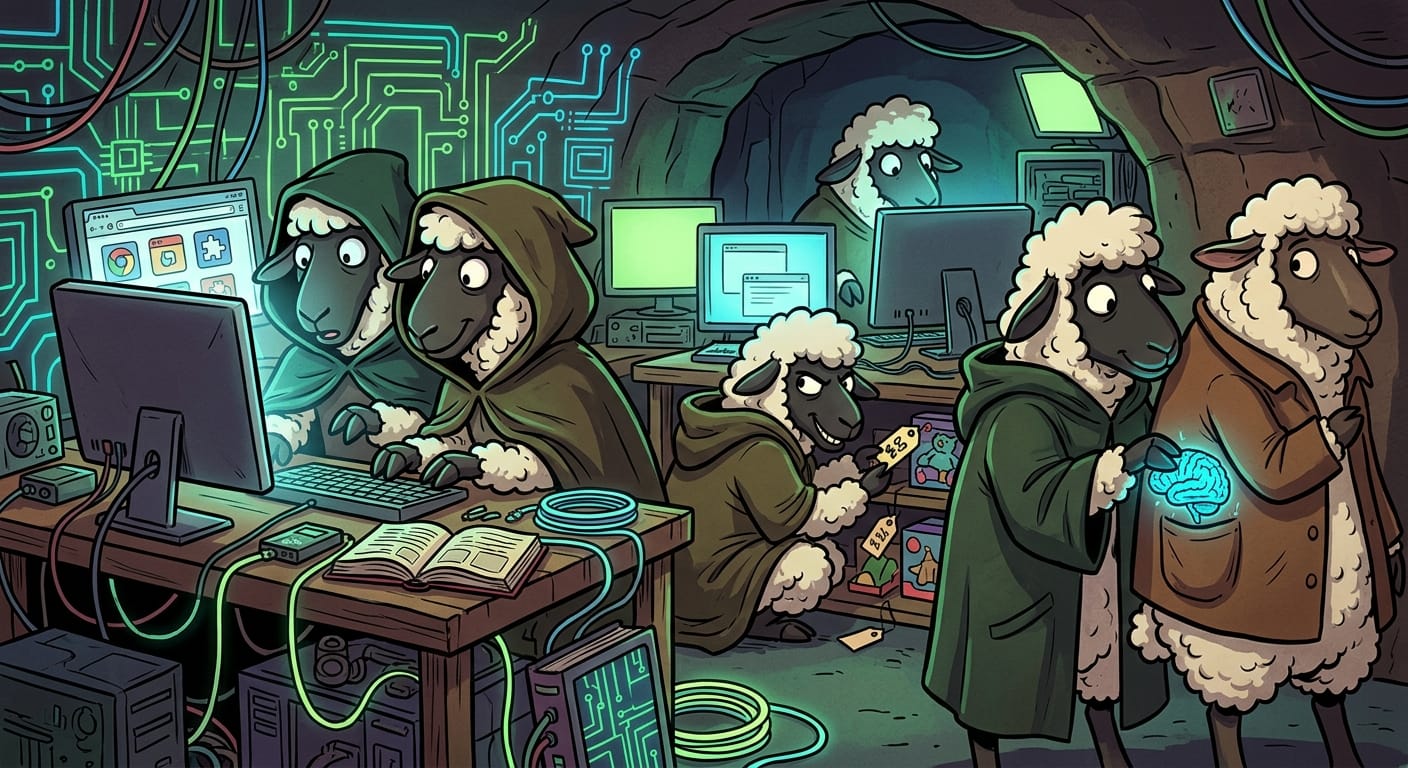
I warned you. I warned all of you. In 1994, over a perfectly adequate 14.4k modem connection, I told my department chair that convenience-first architecture would be the death of us. He laughed. He is presumably still laughing somewhere, blissfully unaware that his flock has been thoroughly infested.
Let us discuss the latest embarrassment.
Security researchers have documented a cluster of malicious browser extensions, specifically targeting Chrome, that have been quietly doing three extraordinarily unpleasant things. They replace legitimate affiliate links with the attacker's own. They exfiltrate data from the lambs who installed them. And they steal authentication tokens granting full access to ChatGPT sessions. All of this, performed by software the flock voluntarily invited into their browsers.
Let that sit with you for a moment.
These are not sophisticated, state-sponsored wolves operating from a hardened bunker. These are opportunistic coyotes who simply set up a fake grain stall in the browser extension marketplace, waited for the lambs to wander over, and helped themselves. The parasites, once installed, embedded themselves quietly into the wool of everyday browsing activity. Ticks, frankly. Classic ticks.
The affiliate link hijacking is almost quaint in its audacity. Every time a compromised lamb clicked a shopping or referral link, the coyote's wallet received the commission instead of the legitimate party. Financially motivated, low-noise, and entirely invisible to anyone not paying attention. Which, based on available evidence, is most people.
The credential theft is considerably more serious. ChatGPT authentication tokens are session keys. Possession of one means the wolf does not need your password. He simply walks through the gate you left open, wearing your coat. From there, he has access to your conversation history, your saved contexts, your integrated workflows. Everything you told that chatbot at 11pm that you perhaps should not have.
And where were the Shepherds during all of this? Approving the quarterly Sky Pasture migration budget, I expect. Signing off on another subscription to some modern, cloud-native, AI-assisted security platform with a friendly logo and absolutely no understanding of what a segmented network topology actually requires.
In the old days, software did not simply install itself from a marketplace. You received it on magnetic tape. You knew exactly what was on that tape. You had documentation. You had a chain of custody. Nobody was slipping ticks into your tape library because the tape library was physically locked in a room that required a key card and a stern conversation with Gerald from facilities.
Now we have a browser extension store containing tens of thousands of entries, reviewed by an automated process, trusted implicitly by a flock that clicks "Add to Chrome" the way a sheep walks into a pen: without hesitation, without curiosity, without any apparent survival instinct whatsoever.
I am not angry. I am simply deeply, chronically unsurprised.
Remediation
The following guidance is offered without optimism, but with professional obligation.
1. Audit your browser extensions immediately. Every single one. If you do not know what it does, why you installed it, or who published it, remove it. The Sheep Tunnel you use for privacy means nothing if you have voluntarily installed a coyote inside the browser itself.
2. Treat the extension marketplace as hostile territory. It is not a curated boutique. It is an open field at dusk. Verify publishers. Check permissions. If an extension requests access to all your browsing data and you installed it to add a dark theme to a recipe website, something is wrong.
3. Revoke and rotate your ChatGPT credentials now. If you have had any unvetted extensions installed in the past six months, assume compromise. Log out of all sessions. Treat your session tokens like you would treat an unsheared sheep in summer: address the situation before it becomes a genuine crisis.
4. Implement an approved extension policy at the organizational level. I recognize the Shepherds will resist this because it requires effort. Implement it anyway. A short list of approved, vetted extensions is not bureaucratic overreach. It is basic fence maintenance.
5. Stop trusting the Sky Pasture to protect you. Cloud-based AI tools are convenient. They are also large, attractive, and full of data that coyotes find extremely interesting. Treat them accordingly.
The hole in the fence was not sophisticated. It never is. It was simply unattended.
It always is.
If it requires a firmware update, I don't trust it.
Original Report: https://thehackernews.com/2026/01/researchers-uncover-chrome-extensions.html