The Sky Pasture's Favorite Runtime Is Collapsing Under Its Own Recursion. Shocking. Truly.

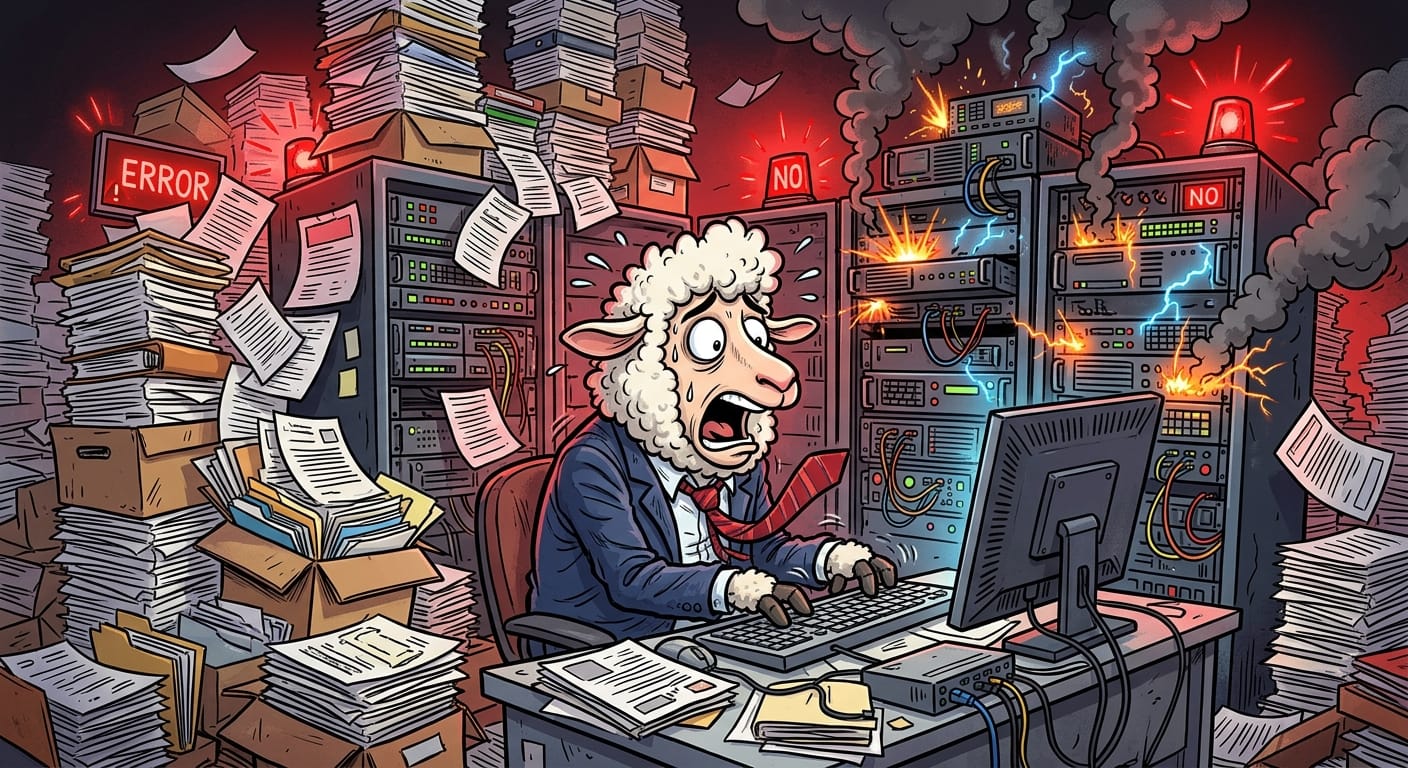
I want you to understand something before we proceed. I warned about this. Not this specific flaw, no, but the general principle: when you build your entire digital infrastructure on a runtime that was invented by a man in his twenties using a language originally designed to make buttons wiggle on web pages, you have made a philosophical error.
And yet here we are.
Node.js, the darling of every developer who thinks "asynchronous" is a personality trait, has disclosed CVE-2025-59466. A critical Denial of Sheep vulnerability rooted in the async_hooks module. The short version: the stack overflows, the server crashes, and your flock stands in the rain with no shelter, confused and damp.
The async_hooks module is meant to track asynchronous operations. Noble enough. But apparently, under the right conditions, it will recurse itself into oblivion like a lamb that has wandered into a mirror maze. The process simply stops. Your production application, the one the Shepherds proudly showed at the quarterly board meeting, falls over.
Most production applications are affected. Most. Let that settle.
In the old days, we did not have this problem. You know why? Because our servers did one thing. One thing, on magnetic tape, sequentially, like a civilized machine. There was no "async." There was "wait your turn." The stack did not overflow because we respected the stack. We feared the stack. The stack was not our friend, it was our landlord, and you do not antagonize your landlord.
Modern developers treat the call stack like a suggestion.
The Wolves, naturally, love this. A remotely triggerable crash with no authentication required is not a vulnerability, it is a welcome mat. Any sufficiently motivated coyote with a crafted request can send your Node.js server to meet its maker. No fleas required. Just math.
Remediation
Node.js has released patches. You should apply the ointment immediately, across all affected versions. This is not optional. This is not "add it to the backlog."
Check your version. If it is unpatched, it is a hole in the fence. Close it.
If your Shepherds ask why this is urgent, you may tell them that the alternative is explaining a production outage to clients who are already suspicious of your infrastructure decisions.
Rate-limit your incoming requests at the Electric Fence layer as a secondary control. It will not fix the flaw, but it reduces the attack surface while your team locates the patch notes they definitely bookmarked and definitely did not lose.
And for the love of all things sensible, consider whether "async all the way down" was ever really a good idea.
It wasn't. I said so in 1997. Nobody listened.
Stay paranoid, the wolves certainly are.
Original Report: https://thehackernews.com/2026/01/critical-nodejs-vulnerability-can-cause.html